
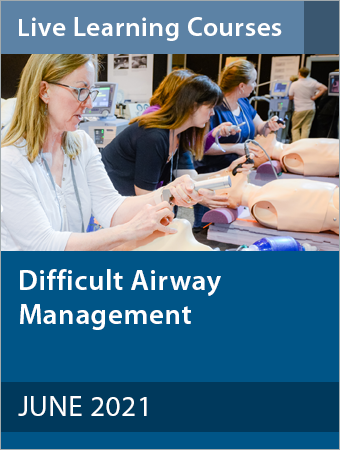
Difficult Airway Management June 2021 (Chestnet)

$150.00
Difficult Airway Management June 2021 (Chestnet) The lecture-based learning for this course will be done online prior to the course date(s). You will receive access to the recorded lectures and will be expected to review all sessions prior to arriving for in-person learning. The in-person session will focus on hands-on, interactive training with expert faculty, who will share their skills and answer questions.
Samples for Courses Can be found here : Free Samples Here!
Format : 10 Videos + 21 PDFs
File Size : 1.37 GB
Difficult Airway Management June 2021 (Chestnet)
Course Format
Target Audience
COVID-19 Safety Precautions
Learning Objectives
- – Describe risk factors, physical exam findings, and clinical situations associated with a difficult airway.
- – Classify the various types of equipment used in the management of the patient with a difficult airway and describe their potential use and limitations.
- – Demonstrate a systematic approach to patient, equipment, and drug preparation prior to intubation.
- – Demonstrate effective management of the patient with a difficult airway.
- – Successfully perform direct laryngoscopy in a clinical environment.
- – Employ video laryngoscopes in difficult airways.
- – Plan for and use extraglottic devices and cricothyrotomy to manage failed airways.
- – Use crew resource management principles to effectively utilize an airway management team, maximizing success and patient safety during intubation.
Content :
Interactive Lectures
Interactive Workshops
- APPROACH: Checklist for Success
- Algorithms: Case-based Discussions
- Panel Discussion: How Do You Do It?
- Taking the Checklist to Your Institution
Hands-on Workshops
- Biomechanics of Intubation: Video Feedback of Technique
- Direct Laryngoscopy, Bag-Valve-Mask, Bougie
- Extraglottic Airways With Fiberoptic Intubation
- Videolaryngoscopy and Other Advanced Airway Tools
- Limited Mouth Opening
- Portable Videoscopes
- Cricothyrotomy
- Management of Tracheostomy Complications
- Awake Intubation
- The Airway Checklist: Every Patient, Every Time
- High-fidelity Simulations: A Teamwork Approach, Crew Resource Management, Difficulty Levels 2-5, Failed Airway and Rescue
Assessments
- Pre- and Post-course Knowledge Assessments—knowledge assessments to be completed on your own time
- Post-course Knowledge and Skills-based Assessment
Related products

Anesthesiology & pain medicine
Dannemiller Updates On Pain Review: Conversations with the Experts 2022 ( VIDEOS)

Anesthesiology & pain medicine
2022 International Liver Transplant Society Annual Congress (ILTS) (Videos)

Anesthesiology & pain medicine

Anesthesiology & pain medicine

Anesthesiology & pain medicine

Anesthesiology & pain medicine

Anesthesiology & pain medicine
Anesthesiology & pain medicine