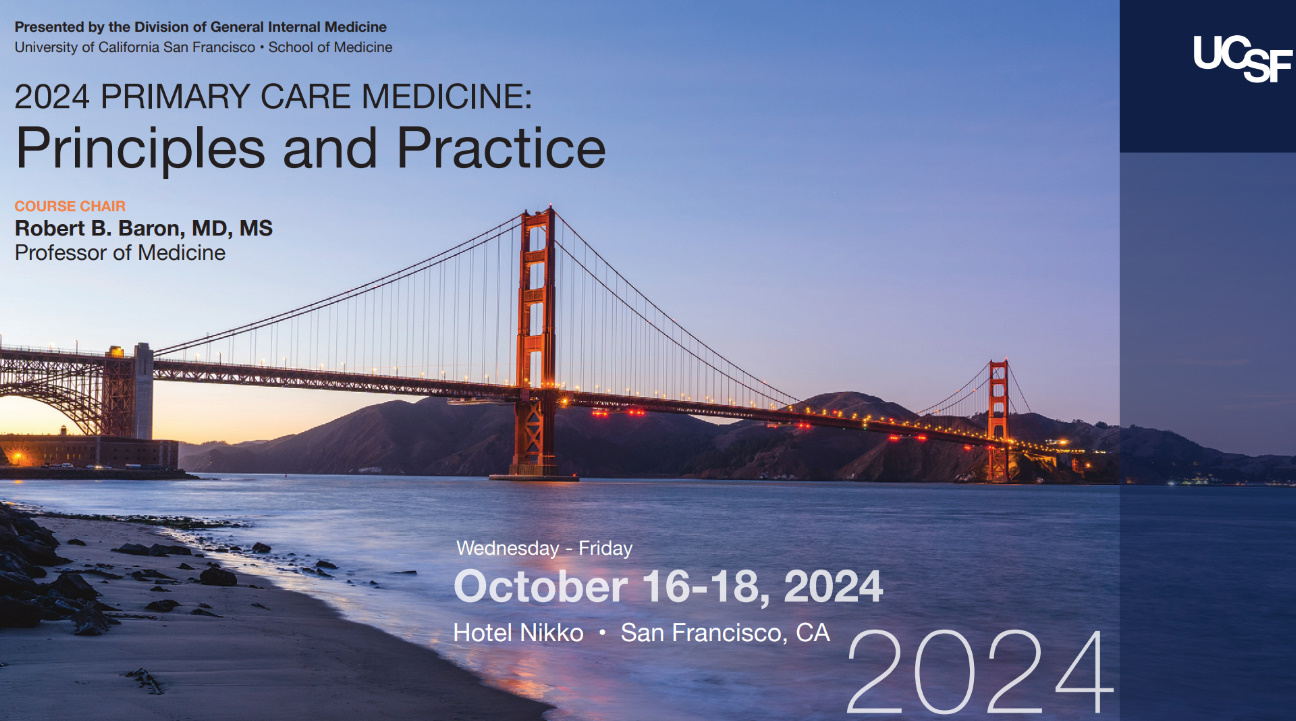
UCSF Primary Care Medicine Principles & Practice 2024

Primary Care is the essential core of modern medical practice. Increasingly difficult management decisions must be made in diverse ambulatory environments and via telemedicine. Primary care clinicians continue to do it all: preventive medicine, reduction of cardiovascular risk factors, acute clinical problems, chronic disease management, women’s health, behavioral medicine, geriatrics, and much more. Effective practice requires understanding the optimal use of new diagnostic tests and new medications. Health disparities and the care of vulnerable patients are a central part of our daily practice as we try to maximize quality, safety, equity, and value. Close collaboration with other specialists, inpatient colleagues, and diverse teams of health professionals is essential for the care of our complex patients.
This course, UCSF’s most comprehensive course in primary care, will present a comprehensive review of new developments in outpatient medicine, controversies in primary care practice, and updates from diverse clinical specialties that impact primary care. The course will focus on the skills and strategies needed in day-to-day office practice. The curriculum will feature in-depth discussion of challenging cases in preventive medicine, common problems in ambulatory care, and a broad selection of acute and chronic illnesses. The course will utilize formal lectures, case discussions, an audience response system, questions and answers, a detailed syllabus, and on-demand access to course recordings. Ample time will be reserved for interprofessional discussion of challenging cases. Remote learning opportunities will also be available.
The course is presented by the UCSF Division of General Internal Medicine of the Department of Medicine and is sponsored by the Office of Continuing Medical Education, University of California, San Francisco.
Target Audience
This course, chaired by Dr. Robert B. Baron and taught by UCSF’s best teachers, is designed for practicing internists, family practitioners, advance practice providers, and all other health professionals interested in providing high quality primary care.
Objectives
The purpose of this course is to increase competence and improve clinician practice in primary care. We specifically anticipate improvements in skills and strategies to:
- Implement new guidelines in office-based preventive medicine, including new strategies for cancer screening, immunizations, prevention of coronary heart disease, stroke, kidney failure, and STIs;
- Manage common office problems including diabetes, coronary heart disease, chronic kidney disease, asthma, COPD, stroke, TIAs, osteoporosis, liver disease, obesity, LUTS, anxiety and depression, sleep disorders, dementia, allergies, orthopedic complaints, and chronic pain;
- Manage common specialty problems in cardiology, endocrinology, infectious disease, pulmonary medicine, hepatology, nephrology, oncology, geriatrics, neurology, urology, dermatology, gynecology, orthopedics, otolaryngology, allergy and immunology, substance use, bariatrics and public health;
- Diagnose and treat common problems in women’s health including cancer prevention, family planning, genitourinary symptoms, and osteoporosis;
- Understand the impact that COVID-19 has had on primary care practice and use best practices to treat patients with COVID-related conditions;
- Understand the impact that Artificial Intelligence (AI) will have on clinical practice;
- Select the best diagnostic tests and enhance value in medical practice;
- Integrate new medications into clinical practice;
- Use best evidence and optimize patient communication and shared-decision making;
- Become a better clinician and advocate with a deeper understanding of health disparities and the central role of primary care clinicians in providing equitable, patient-centered care
+ Topics:
- 01_Walsh_Cancer Screening and Prevention.pdf
- 02_Winston_Vaccinations for Adults and Adolescents.pdf
- 03_Santhosh_Current Approaches to Asthma COPD.pdf
- 04_Murray_Harnessing the Potential of AI in Clinical Medicine.pdf
- 05_Brondfield_Cancer Treatment Today.pdf
- 06_Josephson_New Advances in Stroke Prevention.pdf
- 07_Kim_Type 2 Diabetes Medications.pdf
- 08_Nadler_Common and Commonly-Missed Orthopedic Problems.pdf
- 09_Karliner_Dementia.pdf
- 10_Shlipak_Chronic Kidney Disease.pdf
- 11_Fox_Prevention Detection Treatment Common Liver Disease.pdf
- 12_Jackson_Hot and Dry with a Chance of Wet.pdf
- 13_Schwarz_Stigma, Sanity and Maternal Mortality.pdf
- 14_Schafer_Osteoporosis.pdf
- 15_Ristau_Treating Patients with Substance Use Disorder.pdf
- 16_Pletcher_ENT.pdf
- 17_Chin-Hong_COVID-19 and Seasonal Respiratory.pdf
- 18_Rogers_Older Adults.pdf
- 19_Brondfield_No Longer a Death Sentence.pdf
- 20_Samelson-Jones_Clinical Dilemmas in Psychiatry.pdf
- 21_Gundling_Primary Care AI.pdf
- 22_Soni_Cardiology for the Non Cardiologist.pdf
- 23_Thiara_Obesity.pdf
- 24_Cohen_STIs.pdf
- MDM24M04-postcard.pdf
- OCT 16 AM SESSION.mp4
- OCT 16 PM SESSION.mp4
- OCT 17 AM SESSION.mp4
- OCT 17 PM SESSION.mp4
- OCT 18 AM SESSION.mp4
- OCT 18 PM SESSION.mp4